

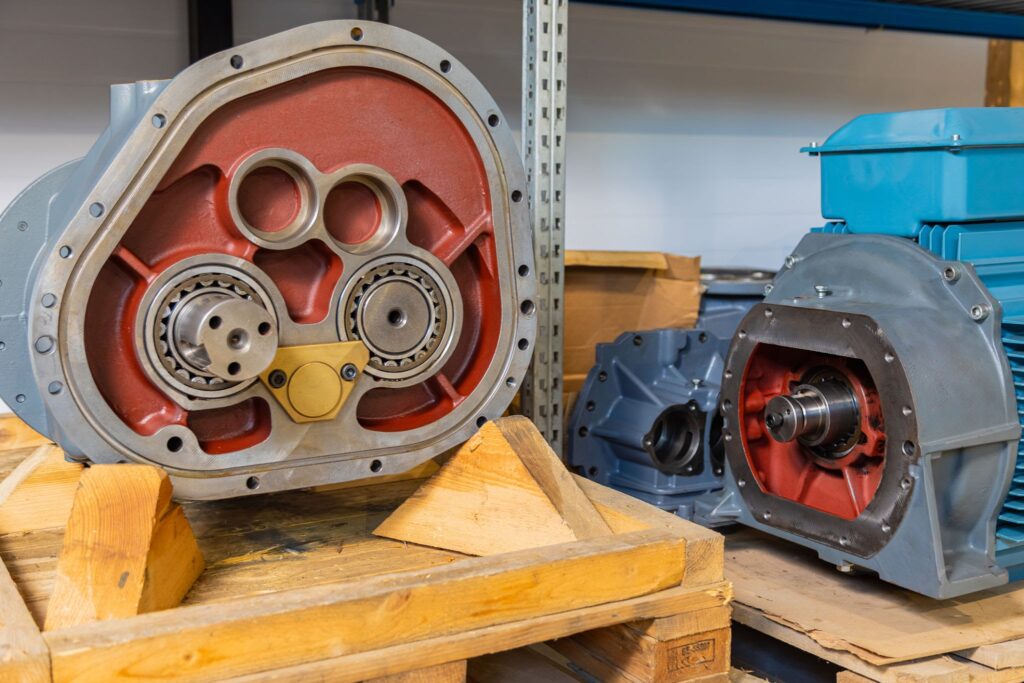
When a critical industrial gearbox fails, the cost goes far beyond the repair bill itself. Every hour of unplanned downtime burns thousands of dollars in lost throughput, delayed shipments, and idle labor.
When searching for a gearbox overhaul or repair partner, you will often hear providers promise “factory-spec” or “heavy-duty” repairs. But how do you verify that their machining tolerances, metallurgy, and tooth geometries actually meet rigorous engineering benchmarks?
That is where AGMA compliance comes in.
What Is AGMA Compliance?
AGMA stands for the American Gear Manufacturers Association. Founded in 1916, AGMA sets the global technical standards for gear design, load rating, material processing, quality classification, and testing.
AGMA compliance means that a design, manufacturing, or repair facility adheres strictly to these standardized technical guidelines during every phase of gear production and repair.
Rather than relying on guesswork or dynamic “eyeball” alignments, an AGMA-compliant provider evaluates and restores gearboxes against standardized mathematical models for:
- Tooth Geometry & Pitch: Exact profiles, lead deviations, and pitch accuracy.
- Quality Classes: Precision levels ranging from standard industrial (Q3–Q8) to high-speed/aerospace tolerances (Q9–Q15).
- Load Rating Formulas: Verifying tooth bending strength and surface durability under peak operational conditions.
- Metallurgy & Heat Treatment: Specifying exact case hardness, core toughness, and surface finish depth.
Key AGMA Standards Governing Gearbox Overhauls
An expert repair shop applies several foundational AGMA standards when rebuilding or reverse-engineering an industrial gearbox:
- ANSI/AGMA 2001 / 2101: Governs fundamental rating factors for spur and helical gear tooth strength and surface durability.
- AGMA 508 / ISO 1328: Specifies procedures for precision testing gear accuracy, runout, backlash, and profile errors.
- AGMA 1104: Outlines best practices for gear surface finishes, coatings, and lubrication regimes.
- AGMA 1202: Directs noise and vibration suppression criteria in power transmission systems.
5 Reasons AGMA Compliance Matters for Your Repair Provider
Choosing a repair provider that enforces AGMA standards isn’t just a technical detail—it’s a financial safeguard for your plant.
1. Guarantees Precise Gear Mesh & Tooth Contact
A gear that “fits” inside a housing isn’t necessarily a gear that will survive. Without exact tooth contact patterns and proper backlash tolerances defined by AGMA standards, gear teeth experience localized stress concentrations. AGMA-compliant shops utilize Coordinate Measuring Machines (CMM) and tooth contact pattern testing to ensure load distribution across the entire face width.
2. Prevents Premature Fatigue and Failure
When gears are re-ground or reverse-engineered, improper heat treatment or incorrect module pitch leads to pitting, spalling, and tooth root breakage. AGMA standards specify exact metallurgical properties (such as carburizing depth and surface tempering checks) that enable gear sets to handle full rated torque and severe shock loads.
3. Drastically Reduces Noise and Vibration
Excessive gearbox noise and high vibration signatures (measured in velocity in/s or mm/s) are direct symptoms of gear tooth deviation or shaft misalignments. Following AGMA 1202 guidelines ensures smooth, quiet power transmission, which protects neighboring bearings, seals, and connected machinery from destructive harmonics.
4. Ensures True Component Interchangeability
If your repair shop manufactures replacement gears on-site, compliance with AGMA nomenclature and tolerances ensures those parts match OEM specifications exactly. You won’t face subtle dimension mismatch problems down the line during routine maintenance.
5. Full Quality Control & Traceability
AGMA compliance mandates detailed inspection reports, non-destructive testing (NDT), dimensional verification, and material certification. If a failure ever occurs, you have a documented audit trail of every tolerance and heat-treat lot.
Quick Comparison: Quick-Fix Shop vs. AGMA-Compliant Provider
| Feature / Protocol | Standard “Quick-Fix” Repair | AGMA-Compliant Precision Overhaul |
| Tolerance Verification | Manual micrometer visual checks | CMM inspection & documented profile accuracy |
| Tooth Contact Testing | Basic mechanical assembly test | Dynamic dye-pattern load distribution testing |
| Metallurgy Controls | Generic steel stock replacement | Specific case-hardened alloy per AGMA ratings |
| Vibration & Noise | Basic spin test | Spectral vibration analysis & AGMA noise benchmarking |
| Quality Assurance | Limited job ticket | Complete inspection report & material traceability |
Protect Your Investment with Standardized Excellence
Outsourcing your industrial gearbox repair to a provider that ignores recognized quality frameworks is a costly gamble. Partnering with an AGMA-compliant repair facility guarantees that your gearboxes are rebuilt to perform as well as—or better than—the original OEM specifications.
Before shipping your next gearbox for service, ask your vendor: “Do your reverse-engineering and gear grinding processes comply with current AGMA quality classifications?” Their answer will tell you everything you need to know about the long-term reliability of your equipment.