

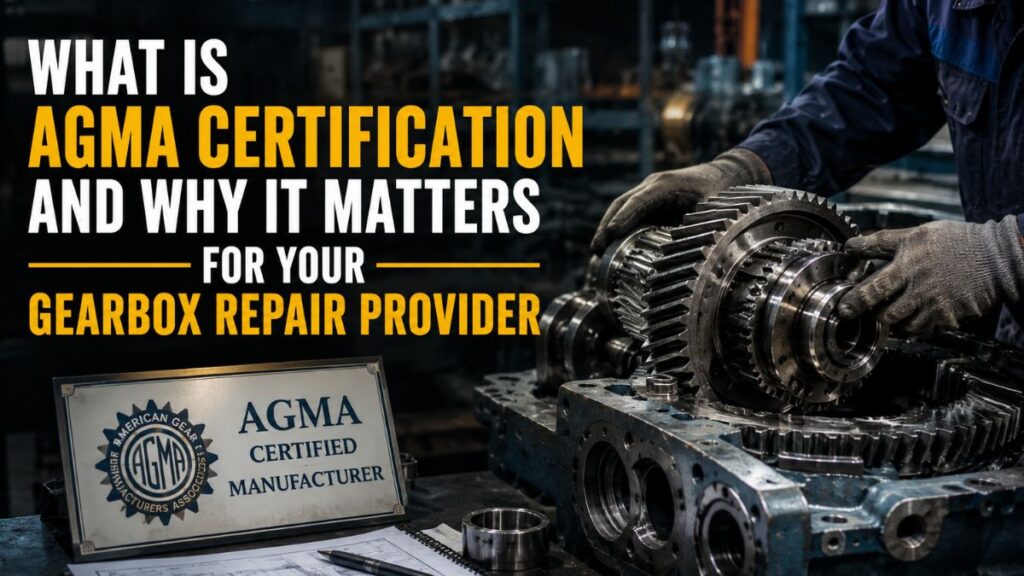
When you are evaluating industrial gearbox repair providers, you will encounter terms like AGMA compliant, AGMA certified, and built to AGMA standards. These phrases carry real meaning. They are not just marketing language.
AGMA is the American Gear Manufacturers Association, and its published standards define the technical requirements for gear quality, material selection, gear rating methodology, inspection procedures, and lubrication practices across the entire industrial gear industry.
Understanding what AGMA compliance means for a repair shop, and knowing how to verify it, is one of the most important criteria for evaluating whether a repair vendor will actually return your gearbox to the performance level you need.
What AGMA Certification Means for Gearbox Repair
AGMA compliance for a gearbox repair shop means that the shop’s rebuild and manufacturing processes conform to the technical standards published by the American Gear Manufacturers Association. These standards define how gears must be measured, what tolerances are acceptable, what quality grades apply to different applications, how gear capacity should be rated, and what inspection methods verify conformance.
For a repair shop, AGMA compliance is an operational commitment. It means every rebuilt gearbox is measured and documented against published tolerance standards, not estimated. It means component replacement decisions are based on dimensional data, not visual judgment. And it means the rebuilt unit’s rated capacity is verified, not assumed.
The AGMA Standards That Matter Most for Repair
AGMA publishes over 150 technical standards covering all aspects of gear design, manufacture, and inspection. For industrial gearbox repair, the most directly relevant standards fall into four categories:
Gear Accuracy Standards (AGMA 2015 / ISO 1328)
These standards define gear quality grades from AGMA Q3 through Q15, where higher numbers represent tighter tolerances. Industrial gearboxes typically require Q8 to Q12 depending on application, speed, and noise requirements.
For a repair shop, conformance to accuracy standards means measuring and documenting tooth profile accuracy, lead accuracy, pitch accuracy, and runout for every gear set that is either repaired or manufactured in-house. A shop that cannot produce accuracy inspection reports to AGMA gear quality grades is not AGMA compliant in any meaningful sense.
Gear Rating Standards (AGMA 2101 / AGMA 6000 Series)
These standards define how to calculate the load capacity of a gear set based on geometry, material, surface finish, and application factors. For repair work, they provide the methodology to verify that a repaired or replacement gear set can handle the rated loads of the application.
When a repair shop replaces a gear set with a custom-manufactured component, AGMA rating standards are what confirm the new gear can carry the same or higher load than the original. A shop without access to AGMA rating calculations cannot make that confirmation.
Inspection and Quality Assurance Standards (AGMA 2116)
These standards define inspection procedures for gear tooth form, pitch, runout, and surface finish. They specify what measurement equipment is required and how measurement results must be documented.
National Gear Repair uses Klingelnberg Inspection Systems for gear inspection, which produces full documentation of profile, lead, and pitch accuracy against AGMA tolerance grades. That documentation travels with the repaired unit and can be provided to the customer on request.
Lubrication Standards (AGMA 9005)
AGMA 9005 covers lubricant selection for enclosed gear drives, including viscosity selection by application, temperature range, and speed. It also covers lubricant change intervals and contamination limits.
For a repair shop, AGMA lubrication standards inform the lubricant specification used when a rebuilt gearbox is commissioned, which directly affects the early-life performance and wear rate of the rebuilt unit.
What Timken, Dodge, and Falk Certification Adds
National Gear Repair’s technicians hold certification from Timken, Dodge, and Falk. These are equipment-specific certifications that add a layer of application knowledge on top of general AGMA compliance.
Timken Certification
Timken is the benchmark in industrial bearing specification and installation. Timken certification means our technicians are trained to the manufacturer’s standards for bearing selection, fit specification, preload setting, and installation practices.
In gearbox repair, bearing selection and installation are the most failure-prone steps in a rebuild. An undersized bearing, an incorrect fit, or an improper preload setting on reassembly creates the failure that the customer will experience 6 months after receiving the rebuilt unit. Timken certification is a verifiable standard for getting this right.
Dodge Certification
Dodge produces a broad range of industrial gear drives, mounted bearings, and coupling products. Dodge certification means our technicians are trained on Dodge product specifications, rebuild procedures, and dimensional standards.
For facilities running Dodge gearboxes, this certification means our technicians work to the same standards as the OEM, not to general estimates of what those standards might be.
Falk Certification
Falk gearboxes are common in heavy industrial applications including steel mills, mining, pulp and paper, and power generation. Falk certification covers Falk-specific rebuild procedures, component specifications, and performance standards.
For Falk units in particular, certification matters because Falk gear drives are engineered to tight specifications and are used in high-consequence applications where a sub-standard rebuild creates significant risk.
What AGMA Compliance Is Not
It is worth being direct about what AGMA compliance does not mean, because the term is sometimes misused.
- AGMA compliance is not a license or formal certification issued by AGMA to repair shops. AGMA is a standards body, not a certifying authority for shops. A shop claiming to be AGMA compliant is claiming that its processes conform to AGMA standards, which should be verifiable through documentation.
- Claiming AGMA compliance without the measurement equipment and documentation practices to support it is meaningless. The meaningful question is not ‘are you AGMA compliant?’ but ‘can you provide AGMA gear quality inspection reports for the work you do?’
- AGMA compliance applies to processes, not to the result of a single job. A shop is AGMA compliant if it consistently applies AGMA standards to every rebuild. A shop that measures some jobs and estimates others is not consistently compliant.
How to Verify a Repair Shop’s AGMA Compliance
When evaluating a gearbox repair provider, these are the questions that reveal whether AGMA compliance is real or claimed:
- What gear inspection equipment do you use, and what accuracy grades can you certify to? A credible answer names specific equipment, such as Klingelnberg or Zeiss gear inspection systems, and references specific AGMA quality grades.
- Can you provide a gear inspection report with the repaired unit? A shop that measures to AGMA standards can produce this report. A shop that cannot produce it is not measuring to AGMA standards.
- What bearing standards do you follow for fit selection and preload setting? The answer should reference specific manufacturer standards (Timken, SKF, or equivalent), not general practice.
- Do you perform load testing before the unit ships? AGMA-compliant repair includes verification of assembled performance, not just dimensional inspection of components.
- What documentation do you provide with the completed repair? At minimum: inspection report, parts list, and warranty documentation. A fully compliant shop can provide gear quality grade certifications.
National Gear Repair provides full documentation on every repair. If you want to see what a certified rebuild process looks like in detail, our complete gear drive rebuild guide walks through every step.
Why This Matters for Your Operation
The practical consequence of AGMA compliance is reliability. A gearbox rebuilt to measured, documented specifications performs predictably. You know what tolerance grade the gears were built to, you know the bearing fits are correct, and you have a documented baseline to compare against when you take future measurements.
A gearbox rebuilt by a shop that estimates rather than measures may perform well, or it may fail in 6 months. There is no way to predict which because there is no documentation to evaluate.
For facilities where gearbox reliability is tied to production commitments, regulatory compliance, or safety-critical applications, the choice between a documented rebuild and an estimated one is not a cost decision. It is a risk decision.
Our 24-Month Warranty is backed by documented inspection at every stage of the rebuild. That warranty means something because the documentation exists to support it.
AGMA Compliance Across Our Service Lines
AGMA standards apply across all of our repair and manufacturing services:
- Gearbox repair and rebuild: all rebuilt units are assembled and verified to AGMA dimensional and performance standards
- In-house gear manufacturing: all gears produced are inspected to AGMA quality grades on Klingelnberg equipment with full documentation
- Planetary gearbox rebuild: backlash setting and carrier assembly follow AGMA standards for epicyclic gear systems
- Mining gearbox service: AGMA rating standards verify that replacement gear sets match or exceed the original load capacity
Frequently Asked Questions
Q: Is AGMA compliance required by law or regulation?
AGMA compliance is not a legal requirement in most jurisdictions. It is an industry-recognized quality standard. However, many industries with safety-critical drive applications, including mining, power generation, and pharmaceutical manufacturing, specify AGMA-compliant repair as a vendor qualification requirement in their maintenance contracts.
Q: What is the difference between AGMA compliant and ISO certified?
ISO 9001 is a quality management system certification that covers an organization’s processes and documentation practices. AGMA compliance is a technical standard covering gear design, manufacture, and inspection specifications. They are complementary rather than equivalent. An ISO-certified shop follows documented processes. An AGMA-compliant shop follows documented processes that specifically conform to gear industry technical standards.
Q: Does AGMA compliance affect gearbox repair cost?
Maintaining AGMA compliance requires investment in precision measurement equipment and trained technicians. This is reflected in pricing. A shop that quotes significantly below market rates is often cutting corners on measurement and documentation. The cost of a non-compliant rebuild that fails in 6 months is always higher than the cost of a correctly priced compliant one.
Q: Can you repair gearboxes to a specific AGMA quality grade on request?
Yes. If your application requires a specific AGMA gear quality grade for the replacement gears, our manufacturing and inspection processes can target and certify to that grade. This is most relevant for high-speed or high-precision applications where noise, vibration, and accuracy requirements demand a documented quality grade.
Q: How does the 24-month warranty relate to AGMA compliance?
Our 24-Month Warranty is underwritten by the documentation we produce during every rebuild. Because every gear is measured, every bearing fit is verified, and every unit is load-tested before shipment, we have a full record of the condition the gearbox was in when it left our facility. That record is what makes the warranty enforceable and meaningful.